
Executive Summary & Quick Builder's Verdict
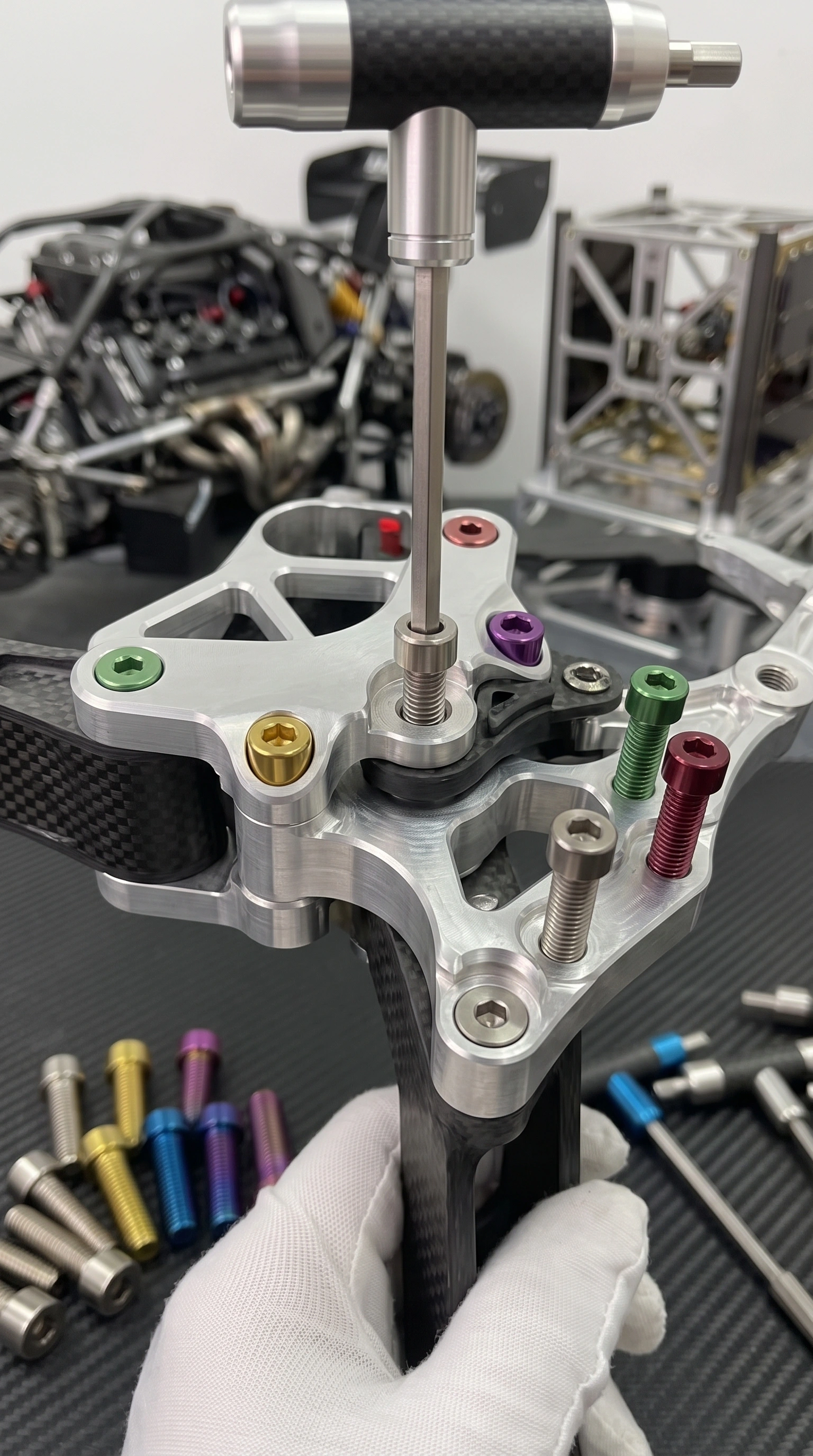
- Why Upgrade Honda PCX Fasteners to Grade 5 Titanium (Ti-6Al-4V)? Beyond the custom aesthetic of CNC-machined flange heads and PVD finishes, swapping factory zinc-plated steel hardware on a Honda PCX125, PCX150, or PCX160 solves three notorious OEM pain points: stripping soft JIS Phillips screws on the brake master cylinder (r/scooters), severe coastal and monsoon rust on exhaust and caliper mounts (r/motorcycles), and high unsprung mass on the unit-swingarm CVT drivetrain (r/scooters).
- Material Selection Rule: Insist exclusively on hot-forged, rolled-thread Grade 5 Titanium (Ti-6Al-4V) for structural chassis, brake caliper (Partzilla 90131-K97-T00), brake rotor (OEM 90105-KGH-900), rear shock (r/PHMotorcycles), and muffler hangers (Partzilla Muffler Diagram). Never use decorative 6061/7075 aluminum bolts on brakes, suspension, or stressed engine covers (r/motorcycles).
- Thread Compound & Torque Discipline: Because almost every bolt on a Honda PCX threads directly into soft die-cast aluminum (fork lowers, eSP/eSP+ crankcase, handlebar risers, or swingarm), apply Blue Loctite 243 on vibrating brake/chassis hardware and Nickel or Metal-Free Anti-Seize (Permatex Nickel, Loctite LB 8009) on exhaust and CVT cover bolts—while strictly respecting Honda's aluminum thread torque limits (r/IndustrialMaintenance).
1. Introduction: Why the Honda PCX Is the Ultimate Platform for a Titanium Hardware Build
From the bustling streets of Bangkok, Manila, and Tokyo to coastal commuter routes across Europe and North America, the Honda PCX—spanning the early JF28/KF12 generations, the LED-equipped KF18/KF30 PCX125 and PCX150, and the four-valve eSP+ PCX160 (KF47)—reigns as the benchmark urban maxi-scooter (Webike Thailand). Engineered around a smooth, fuel-injected single-cylinder engine and a unit-swingarm Continuously Variable Transmission (CVT), the PCX is legendary for mechanical reliability.
Yet any owner who commutes year-round in humid, rainy, or coastal climates—or who regularly pulls the plastics and CVT cover off for variator tuning and tire changes—quickly discovers where Honda's cost-accounting engineers saved money: the factory fasteners (Partzilla PCX150 Catalog). Within twelve months of exposure to road spray, tropical monsoon humidity, or coastal salt air, factory zinc-chromate steel bolts chalk with white zinc oxide and orange rust (r/motorcycles). Worse still, frequently removed fasteners—such as exhaust heat shield screws, brake fluid reservoir cap screws, and bar-end bolts—suffer from cammed-out heads and seized threads (r/scooters).
In the Southeast Asian and Japanese custom scooter scenes (documented across r/PHMotorcycles, r/scooters, and HondaPCX.org), a full or targeted Grade 5 Titanium (Ti-6Al-4V) fastener conversion is one of the most rewarding upgrades for a Honda PCX. Done correctly, replacing key OEM steel bolts with aerospace-grade titanium fasteners eliminates corrosion permanently, sheds 42% to 45% of fastener mass on the unsprung drivetrain/brake assembly, and prevents stripped heads during routine belt and brake service. Done carelessly—using cheap ungraded bolts, choosing shallow button-head sockets, or ignoring wet-versus-dry torque values in soft Honda aluminum castings—it can lead to galled threads, snapped exhaust studs, or stripped crankcase bores.
Drawing on official Honda PCX Service Manual torque specifications, verified Partzilla OEM parts schematics, and real-world wrenching reports from Reddit's motorcycle and scooter communities, this guide walks you through every critical fastener zone on the Honda PCX.
2. Real-World PCX Wrenching Pain Points from Reddit & Builder Forums
Before ordering a single titanium bolt, it pays to examine why stock PCX hardware fails in everyday ownership—and what mistakes riders make when upgrading. Across r/scooters, r/PHMotorcycles, and r/motorcycles, three specific fastener headaches come up repeatedly.
2.1 The Infamous Seized Brake Reservoir Screw and Factory Threadlocker Trap
On the Honda PCX handlebars, both the front disc brake master cylinder (and the rear disc master cylinder on ABS/PCX160 models) use two small M4 × 12 mm countersunk JIS cross-head screws to secure the reservoir cover. Because trace amounts of hygroscopic DOT 3/4 brake fluid weep around the rubber diaphragm and attract moisture, the steel screws corrode into the cast aluminum reservoir body. When an owner tries to crack them loose with a standard household Phillips screwdriver instead of a proper JIS #2 bit, the soft head strips instantly. As one frustrated rider shared in an r/scooters thread on a stripped PCX brake reservoir screw:
"If that fails you can use a drill to remove the head of the screw, remove all shrapnel, lift off the cover, and grab the stub of the screw tightly with a fresh and sharp set of Vice-Grips. Turn once, and with conviction. You get one try at this... And I now replace ALL JIS screws in my machines' brake reservoir covers and carburetors with stainless [or titanium] Allen head fasteners and a bit of antiseize on the threads." — r/scooters
A similar trap awaits riders upgrading the PCX handlebar weights, where Honda applies heavy factory threadlocker to the internal screw, making a hex-socket titanium conversion a major maintenance upgrade (r/scooters handlebar end cap discussion).
2.2 Unsprung Mass on the PCX Unit-Swingarm Drivetrain
Unlike a conventional motorcycle where the engine is bolted rigidly inside the main frame, the Honda PCX uses a unit-swingarm architecture: the entire eSP/eSP+ engine, aluminum CVT transmission case, rear shock lower mounts, muffler assembly, and rear wheel pivot together as a single unsprung mass (r/scooters). As a contributor in r/scooters noted:
"Picture a flat frame trying to support an unsprung 50lbs engine/CVT/axle/swing arm smashing over potholes at 50mph... Honda PCX 160 is great too." — r/scooters
Because every bolt attached to the front fork lower, front brake rotor, brake caliper, CVT crankcase cover, muffler hanger, and rear shock lower mount is 100% unsprung weight, shaving weight in these zones directly complements aftermarket YSS, KYB, or RCB rear shock upgrades (r/PHMotorcycles).
2.3 Why Cheap Anodized Aluminum Bolts Leak Oil—and Why Button-Head Titanium Strips
In budget scooter modification circles, riders are often tempted by kits of anodized aluminum bolts for the CVT cover or brake components. Veteran mechanics on r/motorcycles strongly warn against putting aluminum fasteners anywhere that requires clamping preload:
"Do not use them [aluminum bolts] on anything that requires a specified torque to continue to do its job - like sealing in oil. I had a bike where the PO used AL bolts around the accessory covers, and eventually lead to an oil leak due to the bolts stretching... AL bolts are only good for non-critical dress up, such as fairings." — u/SlidePanda on r/motorcycles
Even when stepping up to real titanium, head geometry matters immensely. As a commenter in an r/motorcycles thread on motorcycle titanium screws cautioned:
"If you are going to buy titanium fasteners, buy socket head cap screws as they have nice deep socket heads. Don't buy button heads as they won't last." — u/Wibbly23 on r/motorcycles
Standard ISO 7380 button-head Allen bolts use a shallower hex broach than DIN 912 socket head cap screws or JDM Dual-Drive (Hex Flange + Internal Torx/Allen) titanium bolts. For any Honda PCX bolt torqued above 10 N· m, always specify Hex Flange, Tapered Socket Cap, or Dual-Drive Torx/Hex Flange Grade 5 titanium bolts.
3. Metallurgy & Engineering Rules for Honda PCX Titanium Upgrades
Before diving into the zone-by-zone part numbers and dimensions, every PCX builder must understand the metallurgical rules governing titanium bolts threaded into Honda aluminum castings.
3.1 Grade 5 (Ti-6Al-4V) vs. Grade 2 (CP Titanium) vs. OEM Steel Grades
On a factory Honda PCX (Partzilla OEM Catalog), general M6 and M8 flange bolts (CVT cover and exhaust heat shield bolts) are property class 8.8 carbon steel (sim 800 MPa tensile strength, 640 MPa yield strength), while high-shear brake caliper mounting bolts (90131-KWN-900 / 90131-K97-T00) and brake disc rotor bolts (90105-KGH-900) are property class 10.9 alloy steel (sim 1,040 MPa tensile strength).
As debated in r/motorcycles, unalloyed Commercially Pure (Grade 2) titanium has a yield strength of only 275 to 380 MPa—less than half that of a standard Grade 8.8 steel bolt! Installing a cheap, uncertified Grade 2 titanium bolt on a PCX brake caliper or rear shock mount is a dangerous downgrade. Conversely, aerospace Grade 5 Titanium ( extTi-6Al-4V, ASTM B348 / ISO 5832-3) with cold-rolled threads delivers 950 to 1,050 MPa ultimate tensile strength and 880 to 920 MPa yield strength at 4.43 g/cm³ (43.6% lighter than steel):
| Fastener Material Grade | Tensile Strength (UTS) | Yield Strength (0.2%) | Density (g/cm³) | Corrosion Resistance | Approved Honda PCX Application Zones |
|---|---|---|---|---|---|
| Grade 5 Titanium (Ti-6Al-4V, Rolled) | 950 – 1,050 MPa | 880 – 920 MPa | 4.43 g/cm³ | Immunity to Rust/Salt | Brake Caliper, Rotor, CVT Cover, Shocks, Exhaust, Handlebars (Partzilla). |
| Grade 2 Titanium (Commercially Pure) | 345 – 450 MPa | 275 – 380 MPa | 4.51 g/cm³ | Immunity to Rust/Salt | Fairing/Plastic Dress-Up ONLY; unsafe for brakes, suspension, or muffler hangers (r/motorcycles). |
| A2-70 / A4-80 Stainless Steel (304/316) | 700 – 800 MPa | 450 – 600 MPa | 7.93 g/cm³ | Very High | Master cylinder cap screws (r/scooters), bodywork, general brackets. |
| 7075-T6 / 6061-T6 Anodized Aluminum | 310 – 570 MPa | 275 – 500 MPa | 2.70 – 2.81 g/cm³ | Moderate (Anodized) | Windshield, License Plate (eBay) & Plastic Trim ONLY; stretches under load (r/motorcycles). |
| OEM Honda Steel (Class 8.8 & 10.9) | 800 – 1,040 MPa | 640 – 940 MPa | 7.85 g/cm³ | Low-Moderate (Rusts) | Factory baseline across all chassis and engine assemblies. |
3.2 Preventing Thread Galling and Galvanic Seizing in PCX Aluminum Castings
Nearly 90% of the bolts on a Honda PCX thread into die-cast aluminum alloys (the left crankcase CVT housing, front fork bottom sliders, upper handlebar bridge, and swingarm arm) (Partzilla PCX150 Catalog). As established in tribological testing (Velocity Bolting) and engineering discussions on r/AskEngineers, pairing a noble titanium bolt with an anodic aluminum casting in road spray creates a 0.75 to 0.85 V galvanic cell, while dry assembly risks galling the softer aluminum threads.
Furthermore, as noted on HondaPCX.org and r/IndustrialMaintenance, Honda's published service manual torques assume a dry zinc-plated steel nut factor (K ≈ 0.20) unless the manual explicitly specifies oil or threadlocker. When you apply nickel anti-seize (K ≈ 0.13) or metal-free anti-seize (K ≈ 0.15) to a titanium bolt threading into an aluminum PCX crankcase cover, reduce dry wrench torque by 20% to 30% so you do not strip the casting.
4. Zone-by-Zone Honda PCX Titanium Bolt Modification Guide & OEM Spec Reference
Below is the model-verified breakdown of the five primary titanium upgrade zones across the Honda PCX125, PCX150 (2013–2022), and PCX160 (2021–2026), complete with OEM Honda part numbers, thread sizes, recommended compounds, and adjusted torque specifications.
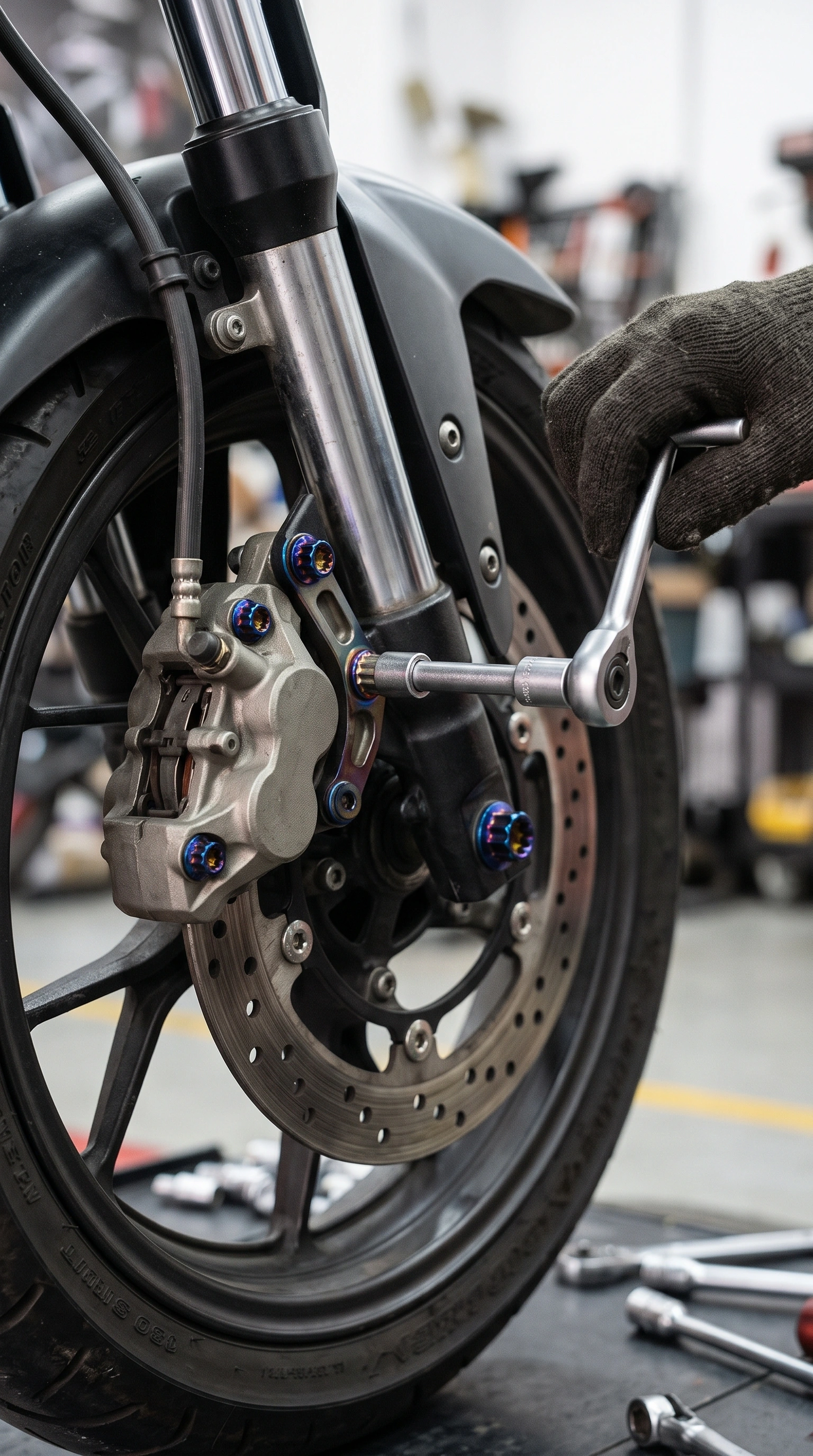
4.1 Zone 1: Front & Rear Braking System (Calipers, Disc Rotors, and Master Cylinders)
- Front Brake Caliper Mounting Bolts (Partzilla Front Brake Caliper Diagram): The Nissin front caliper bracket bolts to the lower fork leg using two M8 × 1.25 × 28 mm (or M8 × 32 mm on ABS brackets) hex flange bolts (Honda OEM Part No. 90131-KWN-900 or 90131-K97-T00). Honda supplies these OEM bolts pre-coated with an anaerobic locking patch (ALOC). When upgrading to Grade 5 titanium flange bolts, clean the female fork threads and apply Blue Loctite 243 (r/BikeMechanics). Torque to 26 –28 N· m.
- Brake Disc Rotor Bolts (Partzilla Front Wheel Diagram): The front brake rotor is secured to the cast aluminum wheel hub by 4 (or 5) low-profile stepped shoulder bolts (M8 × 1.25 × 24 mm, Honda OEM Part No. 90105-KGH-900), plus M5 × 12 mm Torx bolts (90131-K64-N10) for the ABS pulser ring. Crucial Warning: Never replace Honda 90105-KGH-900 rotor bolts with generic fully-threaded M8 bolts! The OEM rotor bolt features a precision unthreaded stepped shoulder (10 mm OD) that locates the rotor concentrically and carries braking shear forces. Purchase only dedicated Honda-spec stepped-shoulder Ti-6Al-4V rotor bolts, apply Blue Loctite 243, and tighten in a star pattern to 38 –40 N· m.
- Caliper Pad Hanger Pin (45215-KPH-951) & Master Cylinder Cap Screws: Coat the threads of a Grade 5 titanium pad hanger pin with Loctite LB 8009 Metal-Free Anti-Seize and torque to 14 –15 N· m (Endurokan PCX Manual). Swap the two M4 × 0.7 × 12 mm master cylinder reservoir JIS screws (r/scooters) for titanium hex/Torx countersunk screws with metal-free anti-seize at 1.2 –1.5 N· m.
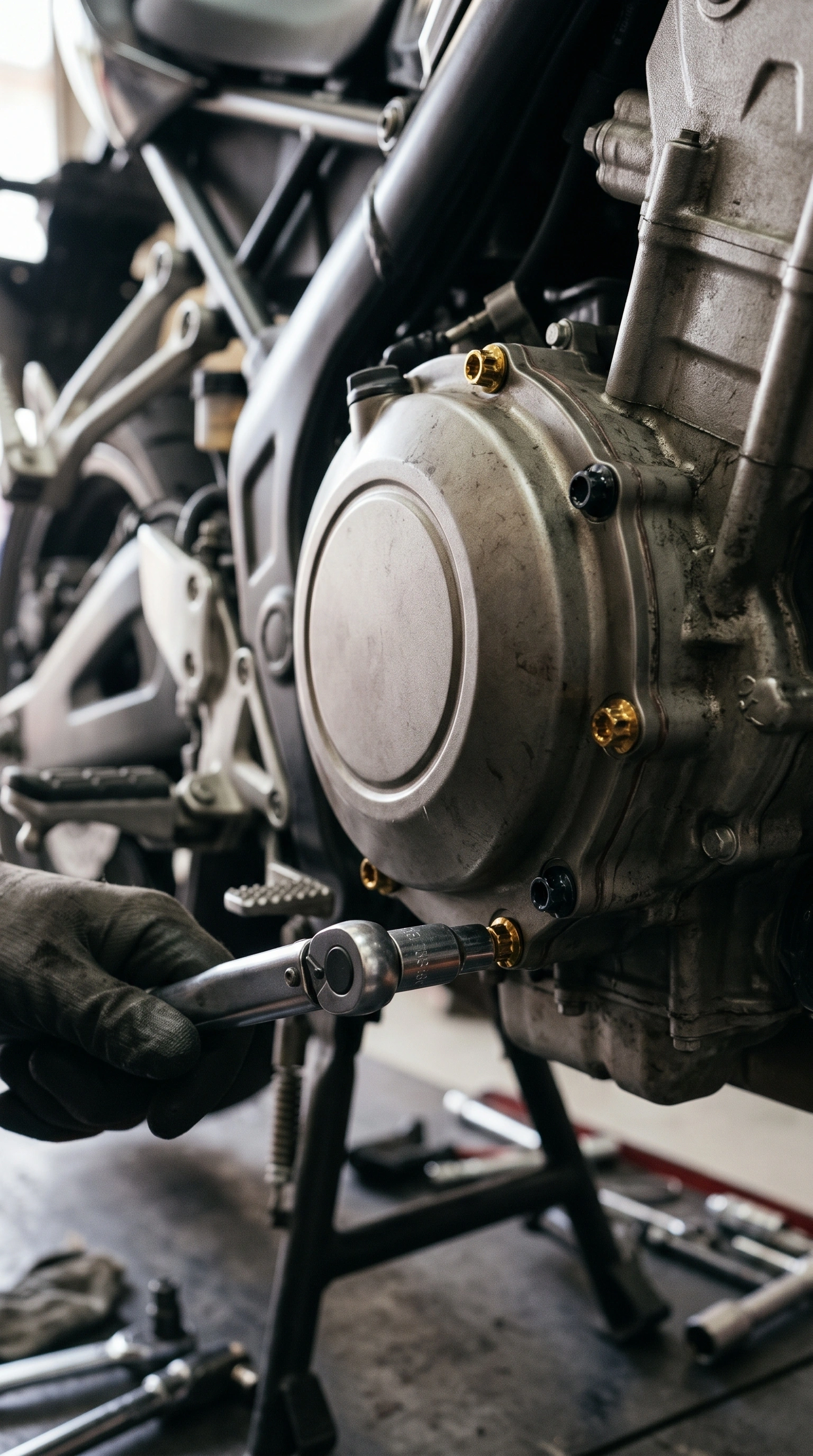
4.2 Zone 2: Left Crankcase CVT Transmission Cover & Air Filter Box
In the Southeast Asian PCX scene (Shopee PH PCX CVT Titanium Sets), the left crankcase CVT cover is the centerpiece of any titanium dress-up kit.
- CVT Cover Perimeter Bolts (Partzilla Left Side Cover): The die-cast aluminum CVT belt case is secured by 8 to 10 M6 × 1.0 hex flange bolts across three lengths: short perimeter bolts (M6 × 25 mm & M6 × 35 mm, Honda 96001-06025-07 / 96001-06035-07) and long dowel-boss bolts (M6 × 65/70 mm, Honda 96001-06070-07).
- Assembly & Torque Warning: Because riders pull the CVT cover every 4,000 to 8,000 km to service the belt and variator rollers (r/scooters), coat every titanium CVT bolt with Nickel Anti-Seize (Permatex Nickel) or Loctite LB 8023 Marine Anti-Seize (r/BikeMechanics). Reduce Honda's 10 N· m dry M6 torque to 7.5 to 8.5 N· m wet (r/IndustrialMaintenance). Keep the internal OEM steel Variator Nut (59 N· m) and Clutch Bell Nut (49 N· m) (HondaPCX.org).
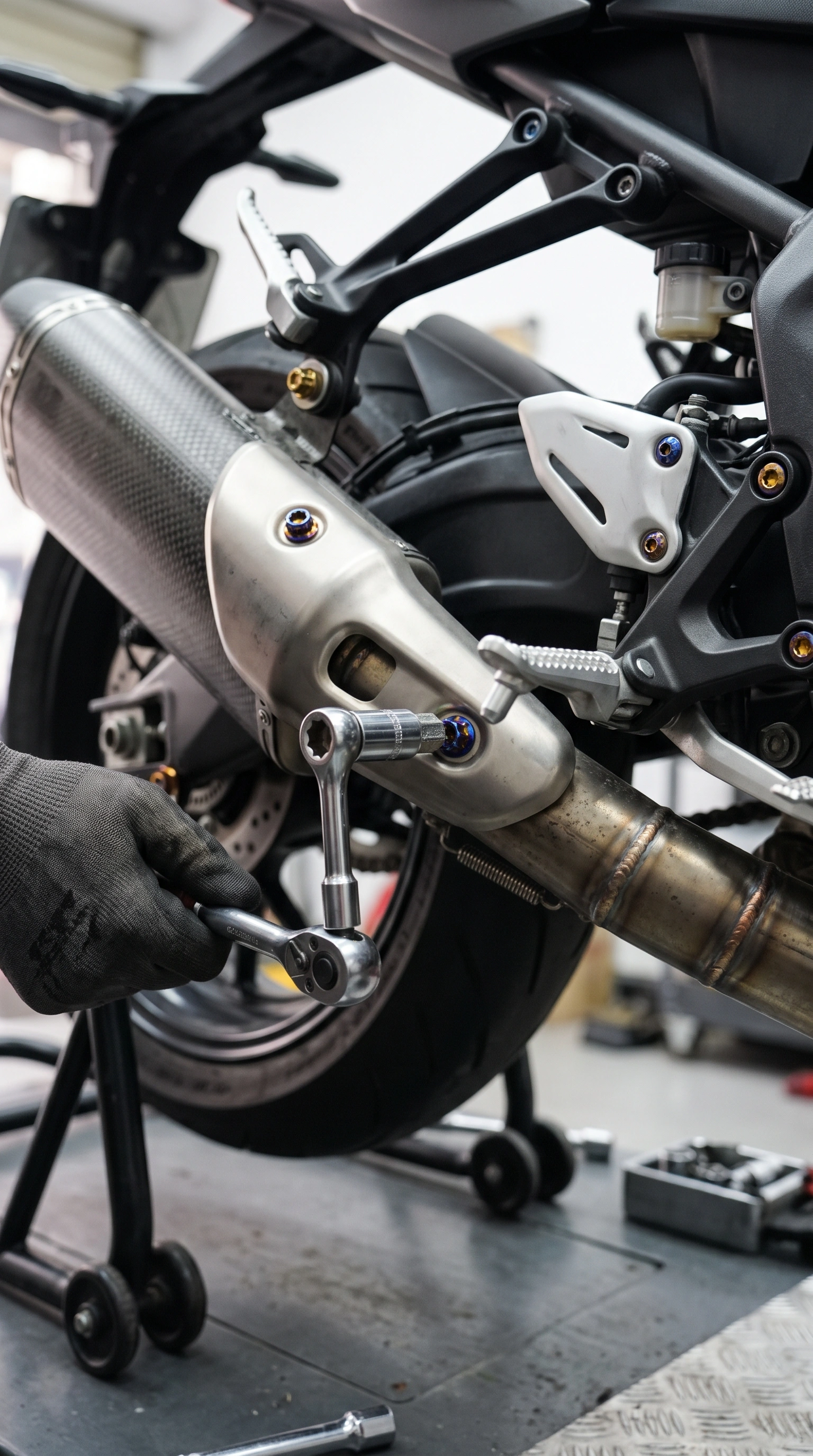
4.3 Zone 3: Exhaust System, Muffler Hanger Bolts & Heat Shield
Every rear tire change on a Honda PCX requires removing the exhaust assembly (r/PHMotorcycles, r/scooters).
- Muffler-to-Swingarm Mounting Bolts (Partzilla Muffler Diagram): Secured to the right-side aluminum swingarm plate via two or three M10 × 1.25 × 55/65 mm fine-pitch hex flange bolts (Honda OEM Part No. 95701-10065-07). Note that Honda uses 1.25 mm fine pitch, not 1.5 mm coarse pitch!
- Torque & High-Temp Anti-Seize: Per the Honda PCX150 Service Manual, OEM dry torque for the muffler mounting bolts is 49 N· m, and 29 N· m for the header pipe joint cap nuts (90304-MJ0-920). Coat the Grade 5 titanium M10×1.25 muffler bolts and header studs generously with Nickel Anti-Seize (Permatex Nickel) or Loctite LB 8009 (Klium), tightening the header cap nuts first to 21 –23 N· m and the muffler hanger bolts to 36 –38 N· m. On the muffler heat shield (M6 × 16 mm, 95801-06016-02), apply Nickel Anti-Seize and torque to 7.5 –8.5 N· m (r/NFA).
4.4 Zone 4: Rear Shock Absorbers & Naked Handlebar Clamp
- Upper & Lower Rear Shock Mounting Bolts (r/PHMotorcycles): The upper shock mounts use two M10 × 1.25 × 35 mm fine-pitch flange bolts, while the lower mounts threading into the aluminum CVT/swingarm boss use two M8 × 1.25 × 32 mm flange bolts. Apply Blue Loctite 243 and torque upper M10 bolts to 35 –37 N· m and lower M8 bolts to 23 –25 N· m.
- Handlebar Upper Clamp Holder Bolts (HondaPCX.org Service Manual Ref.): Four M8 × 1.25 × 28 mm DIN 912 Socket Head Cap Screws (OEM dry torque 27 N· m). Apply Blue Loctite 243 to four Grade 5 titanium socket cap bolts, tighten the two front bolts first to 23 –25 N· m so the front clamp split faces butt solidly together, and then torque the two rear bolts.
4.5 Master Honda PCX Titanium Fastener Specification & Torque Table
| PCX Sub-Assembly & Fastener Location | Honda OEM Part Number Ref. | Thread Size × Pitch × Length | Qty | Recommended Compound | OEM Factory Torque (N·m) | Adjusted Ti Wet Torque (N·m) |
|---|---|---|---|---|---|---|
| Front Brake Caliper Mounting Bolts | 90131-KWN-900 / 90131-K97-T00 | M8 × 1.25 × 28 mm (or 32 mm) | 2 | Blue Loctite 243 (Pre-coated OEM) | 30 N·m (Wet ALOC) | 26 – 28 N·m (w/ Loctite 243) |
| Front Brake Disc Rotor Bolts (Stepped) | 90105-KGH-900 | M8 × 1.25 × 24 mm (10 mm Step) | 4 / 5 | Blue Loctite 243 (Mandatory) | 42 N·m (Wet ALOC) | 38 – 40 N·m (w/ Loctite 243) |
| ABS Wheel Speed Sensor Ring Bolts | 90131-K64-N10 | M5 × 0.8 × 12 mm Torx/Button | 3 / 4 | Blue Loctite 243 | 7 N·m | 6.0 – 6.5 N·m (w/ Loctite 243) |
| Brake Caliper Pad Hanger Pin | 45215-KPH-951 | M10 × 1.0 Fine Thread Pin | 1 | Loctite LB 8009 on Threads | 17 N·m (Endurokan SM) | 14 – 15 N·m (w/ Anti-Seize) |
| Master Cylinder Reservoir Cap Screws | OEM Countersunk JIS Screw | M4 × 0.7 × 12 mm Countersunk | 2 / 4 | Metal-Free Anti-Seize | 1.5 N·m (r/scooters) | 1.2 – 1.5 N·m (Finger Snug) |
| Handlebar Upper Clamp Holder Bolts | OEM Socket Cap Bolt (HondaPCX.org) | M8 × 1.25 × 28 mm Socket Cap | 4 | Blue Loctite 243 | 27 N·m (HondaPCX.org) | 23 – 25 N·m (Front 2 First!) |
| Left Crankcase CVT Cover Perimeter | 96001-06025 / 06035 / 06070 | M6 × 1.0 × 25 / 35 / 70 mm | 8–10 | Permatex Nickel / LB 8023 | 10 N·m (Dry Std) | 7.5 – 8.5 N·m (w/ Anti-Seize) |
| Muffler-to-Swingarm Mounting Bolts | 95701-10065-07 | M10 × 1.25 × 55 / 65 mm | 2 / 3 | Permatex Nickel (High-Temp) | 49 N·m (PCX150 SM) | 36 – 38 N·m (w/ Nickel Paste) |
| Exhaust Header Pipe Joint Cap Nuts | 90304-MJ0-920 | 7 mm / M7 or M8 Cap Nut | 2 | Permatex Nickel | 29 N·m (PCX150 SM) | 21 – 23 N·m (w/ Nickel Paste) |
| Exhaust Heat Shield / Protector Bolts | 95801-06016-02 | M6 × 1.0 × 16 mm Stepped | 2 / 3 | Permatex Nickel | 10 N·m | 7.5 – 8.5 N·m (w/ Nickel Paste) |
| Rear Shock Absorber Upper Mounts | OEM Hex Flange Bolt | M10 × 1.25 × 35 mm | 2 | Blue Loctite 243 | 39 N·m | 35 – 37 N·m (w/ Loctite 243) |
| Rear Shock Absorber Lower Mounts | OEM Hex Flange Bolt | M8 × 1.25 × 32 mm | 2 | Blue Loctite 243 | 26 N·m | 23 – 25 N·m (w/ Loctite 243) |
| Engine Oil Drain Bolt (Reference) | OEM 12 mm Head Drain Bolt | M12 × 1.5 Drain Plug | 1 | Fresh Crush Washer + Oil Film | 24 N·m (Honda OM) | Keep OEM Steel or 18 N·m Max |
5. Step-by-Step Installation SOP for Your Honda PCX Titanium Build
- Use Both 1/4 -inch (2 –25 N· m) and 3/8 -inch (15 –80 N· m) Torque Wrenches: Never use a large automotive torque wrench on small M6 PCX crankcase threads.
- Swap Bolts One at a Time: On the handlebar clamp, brake caliper, and CVT cover, remove and replace one bolt at a time to keep gaskets aligned and prevent radial side-loading that initiates titanium thread galling (Velocity Bolting).
- Verify Blind-Hole Length With a Caliper: Match the under-head length of every titanium bolt against the removed OEM bolt so it cannot bottom out inside a blind aluminum crankcase hole.
- Chase Old Factory ALOC Threadlocker Residue: Clean female fork and hub threads with an M8 × 1.25 thread chaser and non-chlorinated brake cleaner (Huron Industries) so the new bolt spins in 4–5 turns by hand.
- Caution on the PCX Oil Drain Bolt (24 N· m OEM Spec): As veteran owners warn on HondaPCX.org, Honda's 24 N· m drain plug spec (Honda 2019 PCX150 Owner's Manual) is notoriously aggressive for oil-wet aluminum threads. If using a magnetic titanium drain bolt, install a fresh aluminum crush washer and cap torque at 16 to 18 N· m.
6. How to Spot Fake or Low-Grade Titanium Bolts Online
Many marketplace listings (eBay PCX Screws, Shopee PH) advertise "Titanium Color Bolts" where "Titanium" refers only to the paint shade over cheap aluminum or stainless steel. Verify every kit before installation:
- Check the Alloy Spec: Insist on Grade 5 / Ti-6Al-4V / GR5 / TC4—never Material: Aluminum (eBay).
- The Gram Scale Test: An OEM steel M8 × 28 mm caliper bolt (90131-KWN-900) weighs sim 16.5 g. A genuine Grade 5 titanium bolt weighs 9.2 –9.6 g (~43% lighter). If it weighs 16+ g, it is PVD stainless steel; if it weighs 5.5 g, it is aluminum and unsafe for brakes or suspension (r/motorcycles).
- The Magnet & Fillet Check: Genuine Grade 5 titanium is non-magnetic and features cold-rolled threads with a smooth under-head fillet (Velocity Bolting).
7. Frequently Asked Questions (FAQ)
- Are PCX125, PCX150, and PCX160 bolt sizes interchangeable? Caliper (M8 × 28/32 mm), stepped rotor (M8 × 24 mm), handlebar (M8 × 28 mm), and muffler hanger (M10 × 1.25) bolts are shared across generations (Partzilla), but the 4-valve PCX160 (K1Z) uses a different CVT cover bolt pattern than the 2-valve PCX150 (K97) (Shopee PH).
- Can I torch-anodize titanium PCX brake bolts at home? Never heat structural brake or suspension bolts above 550^circ C with a torch, as overheating creates a brittle "alpha case" oxygen layer that reduces fatigue life. Stick to factory electrochemical anodizing or PVD coatings.
- How do I restore faded burnt-blue titanium bolt heads? Wipe the heads with isopropyl alcohol or glass cleaner to remove oil film; never use abrasive metal polish, which strips the nanometer-thin TiO₂ color layer.